HIST 416
When I first saw all of the books required for this class, I was shocked! Besides the cost to purchase the books, the reading will be heavy. When I looked through one of the books, it looked like it would be a very interesting and entertaining story.
I look forward to the readings and sharing my thoughts. I just hope that I can keep up!
The featured image is of Cerritos Beach, just north of Cabo San Lucas (not a border town).
Module 2.2
Readings: Gloria Anzaldúa, Borderlands/La Fronter, and Tim Marshall, The Age of Walls
Gloria Anzaldua sheds some light on the experience of living on a border in her book, Borderlands/La Frontera. She describes the life of being a border woman, living between cultures in uncomfortable territory, full of contradictions, anger, hate, and exploitation. Gloria Anzaldua’s definition of a border is emotional, and indicates separation, “Borders are set up to define the places that are safe and unsafe, to distinguish us from them… created by the emotional residue of an unnatural boundary… in a constant state of transition” (Anzaldua 1987, 3). This methodology indicates that Anzaldua would know about the subject matter because she lived it. Her writing is from first-hand experience, not something learned in a book, and not just full of facts.
Throughout the book, Anzaldua shares poems and stories written by people that have been affected by border life. The very descriptive and emotional writing takes you to a place where you experience their feelings and thoughts. From the information provided by Anzaldua, and the addition of personal stories from others, you are provided a different viewpoint of the history. It brings a human perspective to the story, you get a feeling that the border is not just a wall, it has affected people’s lives throughout time. The sense of division is strong.
Anzaldua speaks of the hardships of the indigenous people of the area and how they have been mistreated, exploited, and murdered throughout time. Evidence of Ancient Indian ancestors found in Texas dated to 35,000 B.C. They were the original caretakers of the land. In the 16th century, millions of Indians died under the Spanish Conquest or by diseases brought by foreigners. In the 1800’s the native Texans of Mexican decent were illegally invaded by Anglos and forced off their land. This invasion forced Mexico to fight to keep the land. In 1846, the U.S. troops invaded and occupied Mexico. The Mexican American War lasted from 1846-1848. On February 2, 1848, the Treaty of Guadalupe-Hidalgo ended the war and initiated the border fence, with the U.S. obtaining what is now Texas, New Mexico, Arizona, Colorado and California. The treaty was never honored, and land promised to Mexico was swindled away. White superiority philosophies provided justification for Anglo-Americans to believe they were the proprietors of the land. More land was taken from the Indians and Mexicans. They were threatened by Anglo-terrorism, many fled, some were lynched, others murdered. In the 1930’s the agribusiness hired Mexicans to work the land that once belonged to them.
Anzaldua expresses the difficulties experienced when attempting to illegally cross the border, “Faceless, nameless, invisible, taunted with “Hey cucaracho” (cockroach). Trembling with fear, yet filled with courage, a courage born of desperation” (Anzaldua 1987, 11). They are taken advantage of by smugglers and robbers, they may die in the desert heat, and woman are especially at risk. If the illegals make it into the U.S., Anzaldua explains their life as, “Living in a no-man’s-borderland, caught between being treated as criminal and being able eat, between resistance and deportation, the refugees are some of the poorest and the most exploited of any people in the U.S.” (Anzaldua 1987, 12).
The border does not create division, humans created the division. Throughout Anzaldua’s book there are stories of us and them. The adversities are created because humans are different.
Tim Marshall says that it seems easier to divide than unite. In the Introduction to the book, The Age of Walls, Marshall discusses how “we build walls for different reasons because we are divided in many ways, in race, wealth, religion, and politics…walls are being built along borders everywhere, and despite globalization and advances in technology, we seem to be feeling more divided than ever” (Marshall 2018, 1,2). Marshall further explains, “When faced with perceived threats – financial crisis, terrorism, violent conflict, refugees, immigration, gap between rich and poor – people cling more tightly to their groups” (Marshall 2018, 4). People will continue to group together for protection against perceived treats. “Threats don’t just come from the borders, they can also come from within” (Marshall 2018, 7).
We need more community, more working together to create positive outcomes, more humane treatment of others. How do we achieve this in today’s world of division? As Marshall said, “It’s essential to be aware of what has divided us, and what continues to do so, in order to understand what’s going on in the world today” (Marshall 2018, 3).
References
Anzaldua, Gloria. 1987. “Borderlands/La Frontera.” Preface and Chapter 1. San Francisco, CA: Aunt Lute Book Company.
Marshall, Tim. 2018. The Age of Walls. New York, NY: Scribner.
Module 3.2
Reading: Rachel St. John, Line in the Sand, A History of the Western U.S. – Mexico Border
“Long before the border existed as a physical or legal reality it began to take form in the minds of Mexicans and Americans who looked to maps of North America to think about what their republics were and what they might someday become” (St. John, 2011, p. 2). There was much to contemplate. Mexico and the United States (U.S.) were both new nations, they did not know what to expect, they did not have previous experience in nations and borders. They could not have imagined what it would take for them to become nations, to be neighbors and work together. Things take time, change is made in increments, and lessons are learned through mistakes that are made.
“History is always a balance between change and continuity, and the history of the border is no exception. Questions about the control of space, the negotiation of state sovereignty, the significance of national identities have been entangled with the boundary line since its creation and continue to define the border today” (St. John, 2011, p. 5).
In the early nineteenth century, territorial completion was of top importance to North America. In the early 1800’s, American Expansionism influenced the U.S. to acquiring more western states. John Quincy Adams, the founder of American Expansionism, wanted to redraw the border so that Texas, New Mexico, California, parts of Baja become U.S. The Mexican political leaders repeatedly rejected the offers. The U.S. annexed Texas in 1845, and in 1846, the U.S. troops invaded and occupied Mexico. A battle for control of the land began and the Mexican American War lasted from 1846-1848.
On February 2, 1848, the Treaty of Guadalupe-Hidalgo was signed to end the war. “The treaty remade the map of North America. In exchange for $15 million, the northern half of Mexico became the southwestern third of the United States” (St. John, 2011, p. 22). A problematic boundary line was drawn with little knowledge of the land and the use of faulty maps. Article V of the Treaty provided for the mapping and marking of the boundary line. Each nation was to appoint a commissioner and surveyor. This would prove to be a difficult task for both nations, and it would take seven years to complete.
There was still conflict regarding the boundary lines. The U.S. Government attempted to purchase more territory during the 1850’s. In 1852 there were disputes about the boundary line in the Mesilla Valley. The Gadsden Treaty was negotiated, and the western boundary line was settled, which providing additional land to the U.S. The new boundary line was completed in 1855 and was satisfactory, however there was still conflict in the borderlands. Territorial sovereignty was a constant struggle for power.
U.S and Mexican soldiers battled to establish military sovereignty, Apache Indians fought for military dominion, and American and European filibusters wanted to build empires. Local people claimed the line through the construction of ranches, railroads, businesses, and homes. Mexico struggled to defend itself and looked for ways to shore up sovereignty along the border, which was just a line running through the land. The borderline was changing the landscape of power in the territory.
Every time the border line changed, it affected people. There were many times that land was taken from people, without permission or compensation. The U.S. and Mexico had had exchanged land that was claimed and occupied by Indians. “The Mexican people believed that the sale of national territory was an insult to national honor and a devastating blow to the nation” (St. John, 2011, p. 35). The territory was a source of hope and pride for the Mexican people, who believed that the land could make them strong. The land meant power to U.S. and Mexico, the Native people and those that lived and worked along the border.
There were problems with defining national territory and state power. Policies were conditional, unclear and unfair, power was compromised. Nation-states adopted controls, regulations, restrictions, and international law to control transborder movements. “What emerged on the border was a form of negotiated sovereignty in which both nation-state modified their plans in response to practical difficulties, transnational forces, local communities, and the actions of their counterparts across the line” (St. John, 2011, p. 7). The nation-states cooperated to build common goals and binational ties to bring law and order to the border.
“Over the next 80 years the western border would experience dramatic changes and take on new meanings as a result of historical developments in the region, the continent, and the world” (St. John, 2011, p. 3).
References
St. John, R. (2011). Line in the Sand, A History of the Western U.S. – Mexico Border. Princeton, NJ: Princeton University Press. Retrieved from https://brytewave.redshelf.com/library/
Module 4.2
Reading: José Angel Hernández, Mexican American Colonization during the Nineteenth Century
Blog Post Coming Soon!
Module 6.2
Reading: C.J. Alvarez, Border Land, Border Water
Blog Post Coming Soon!
Module 7.2
Reading: Kelly Lytle Hernández, ¡Migra!
Hernandez shares a history of the U.S. Border Patrol, from its inception to its 50th anniversary. She describes how it took a community of scholars, activists, archivists, and historians; tours and stories from the Border Patrol and family members; and financial support from institutions to conduct the research and develop the ideas for the book. Her interest began as a teenager, where she interviewed undocumented families and laborers living in the migrant camps in the canyons of San Diego County. Hernandez was later provided an invaluable opportunity to index Immigration and Naturalization Service (INS) files held at the National Archives and Records Administration (NARA), and she was given access to National Border Patrol Museum (NBPM) records, photos, and files. Hernandez explains how the Border Patrol records sat undisturbed for decades, and how a vast majority of correspondence records remained lost in stacks of the NARA, unseen since 1957. These records offered a new insight into the development of U.S. immigration patrol practices, and the contributions made by the Border Patrol officers and border communities.
The history of the U.S. Border Patrol unfolds in the wild west, in a time of cowboys and Indians, outlaws and banditos, farmers and ranchers, and pioneers and miners. The Texas and Mexico borderlands were dominated by Indian tribes and the Texas Rangers were formed to protect the Anglo-American settlements. The Rangers principle strategy was physical violence. The U.S. Border Patrol evolved from the Texas Rangers.
The Border Patrol was created to enforce U.S. immigration by policing borderlands, prevent unauthorized border crossings, and detect and arrest unauthorized immigrants. “Established in May of 1924, the U.S. Border Patrol’s broad police powers rested in its mandate to protect the national interest by enforcing federal immigration laws” (Hernandez, 2010, p. 17). However, in the 1920’s and 1930’s, the immigration law enforcement was not yet developed, or regionalized. Border Patrol officers had to forge new paths of immigration law-enforcement, and make decisions without training, guidance, or supervision. They learned how to use their authority in the pursuit of migration control, which usually included violence. They used their position to command respect and to achieve upward social mobility in the community. There was conflict among officers, immigrants, and community members over the violence used to control human mobility.
During those early years of settlement there was a huge increase in agricultural production. The agribusiness needed a seasonal labor force, willing to work for low wages. Mexican nationals could earn more money working in the U.S., where they migrated in search of work and higher wages. “In the 1920’s the Mexican labor emigration surged with the massive expansion in southwest agribusiness” (Hernandez, 2010, p. 26). However, the threat of deportation maintained a control over the Mexican immigrant labor force. Migrants may find themselves living as fugitives at the mercy of their employers.
Migra! describes how “Mexican immigrant workers emerged as the primary targets of the U.S. border patrol and how it shaped the story of race in the United States” (Hernandez, 2010, p. 2). Hernandez introduces a personal outlook as to how “Mexicans in the borderlands, regardless of immigration or citizenship status, were subject to high levels of suspicion, surveillance, and state violence as Border Patrol Officers aggressively policed not only the U.S.-Mexico border but also Mexican communities and work-sites” (Hernandez, 2010, p. 2).
The border and its laws were continually changing with the times and circumstances. “Border patrol practice was a site of constant struggle. Employers, immigrants, Border Patrol officers, bureaucrats, Mexican politicians, nativists, Mexicana American activists, and many others battled over the translation of U.S. immigration restrictions into the social reality in the U.S.- Mexico borderlands” (Hernandez, 2010, p. 4).
The book provides a history of bi-national politics and practices of controlling Mexican migration. It discusses a history of human rights, the generation of immigrant rights and civil liberties. The book is arranged in 3 chronological parts, Formation – the U.S. Border Patrol’s first 50 years, between 1924 – 1974; Transformation – WWII to 1940’s; and Operation Wetback and Beyond – the decade of 1944-1954.
Hernandez shows some bias in her writing, most likely from hearing personal stories of the undocumented families and laborers living in the migrant camps. Her experience of opening Border Patrol records that sat undisturbed for decades was most likely very emotional. The book does provide a history of the U.S. Border Patrol and its struggle to find an effective immigration law enforcement and a history of the Mexican people and their struggle for financial and social freedom.
References
Hernandez, K. L. (2010). Migra! a History of the U.S. Border Patrol. Los Angeles , CA: University of California Press.
Module 8.1
Reading: Francisco Cantú, A Line Becomes A River, Dispatches from the Border
Francisco Cantú provides a unique and personal perspective as an agent of the Border Patrol. He transports the reader to a day in the life of an agent. Cantú shares the difficult situations that agents encounter, and he shares his inner feelings of the despair and hopelessness he witnesses. Cantú’s writing offers a first-person glimpse inside a story of history on the U.S.-Mexico border.
The book, A Line Becomes A River, Dispatches from the Border, is separated into three sections. Part One tells of Cantú’s experiences during training as an agent, and of his mother’s concern of him becoming part of a “system with little regard for people”. He continues with real events that he experiences as an agent, and how the horrors he observes during the daytime turn into nightmares in his sleep.
In Part Two, Cantú shares stories of his experience as an intel agent and the information he learns. He hears stories of the violence of the cartel, kidnappings, and drug massacres. He talks about the Migrant’s journey and their difficulties to get to the U.S., only to die in the desert or to get sent back to Mexico. Stories of human smugglers, women abducted from the streets, taken to safe houses where they were raped, tortured, murdered. The nightmares continue, and Cantú tells his supervisor that he is accepted for a research scholarship to study abroad.
Part Three begins with Cantú describing his job at a coffee shop in a small business complex. He tells of his growing friendship with another worker at the complex who travels to Mexico and is unable to return to the U.S. Cantú follows legal channels to help his friend return, but Jose is denied. Cantú experiences what it’s like to see the other side of the border story.
Cantú brings a personal touch to the border story on many levels. He was raised in the southwest, growing up near the border, and living in deserts and national parks where his mother worked as a park ranger. He appreciated and respected the beauty and openness of the deserts and scrublands. Cantú tells of fond childhood memories with his mother, spending time in the Chihuahua grasslands and the Guadalupe Mountains. He is proud of his Mexican ancestry, to carry on the name of Cantú, and speaks of his relatives’ dedication to family and tradition, love, and tenacity.
His mother questions his decision to work with the Border Patrol, worried about his safety and how it may change him. He explains to her that most of the migrant people are good, and Border Patrols agents will be arresting them, whether it is him or not. Cantú feels that he can help people; he speaks both languages, knows both cultures, has lived in Mexico, and traveled across the country. He wanted to see the realities of the border, understand it better, and bring some comfort to those affected. He felt the Border Patrol position was only a part of his education, he would possibly study law and shape new policies; experiences with the Border Patrol would bring a unique knowledge and perspective. He reveals to his mother, “I know there’s something here I can’t look away from. Maybe it’s the desert, maybe it’s the closeness of life and death, maybe it’s the tension between the two cultures we carry inside us. Whatever it is, I’ll never understand it unless I’m close to it” (Cantú, 2018, p. 23).
The real, day to day Border Patrol experiences were overwhelming for Cantú. He was plagued by nightmares of his experiences as an agent, and he leaves the patrol after four years for civilian life. His life is simplified by his quiet job at a coffee shop in a business complex. A friendship develops with Jose, a man who maintains the courtyard in the building. They share breakfast together every day for two years. They talk about family, and Jose shares photos of his family and the village he is from in Oaxaca. One summer Jose travels back to Mexico to attend his mother’s funeral and is unable to return to the United States. Cantú rallies with Jose’s wife, employer, and pastor to legally bring Jose back. Even though Jose lived and worked in the U.S. for 30 years, with a wife and children, he was denied entrance.
Jose attempted to return to the U.S. several times, illegally, but was apprehended each time. Cantú wishes that he can help his friend return to his family. In the last chapter, Cantú is in Mexico talking with his friend. Jose expressed his feelings and reasons why he must return, “I realize that I am crossing illegally… but it is necessary because my family is there. The government is separating us… destroying my family… I could feel the power they held over us” (Cantú, 2018, p. 238). Jose tells Cantú that deportees build up a record and it becomes harder to become legal. The U.S. is making criminals out of those who could become its very best citizens and the judges know that they are sending people to their death.
By the end of the book you have a better understanding of life for those in the border lands. The lives of the people whose ancestors struggled to survive and fight for their land, and those that migrated for a better life. The story of those that are hired to control the human travel across the border. Cantú writes of experiences with Mexican migrants, both in a professional and personal level, providing a perspective of real people and real-life issues. This is not a book on the history of the borderlands, but a story of personal life experiences of individuals, friends, and families.
The Line Becomes A River, “I stood to walk along the adjacent shorelines, crossing the river time and again as each bank came to an end, until finally, for one brief moment, I forgot in which country I stood. All around me the landscape trembled and breathed as one” (Cantú, 2018, p. 247).
References
Cantú, F. (2018). The Line Becomes a River, Dispatches From the Border. New York, NY: Riverhead Books.
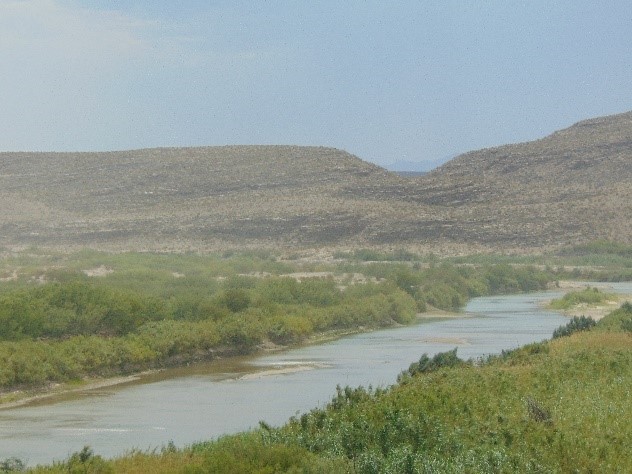
Big Bend, Texas
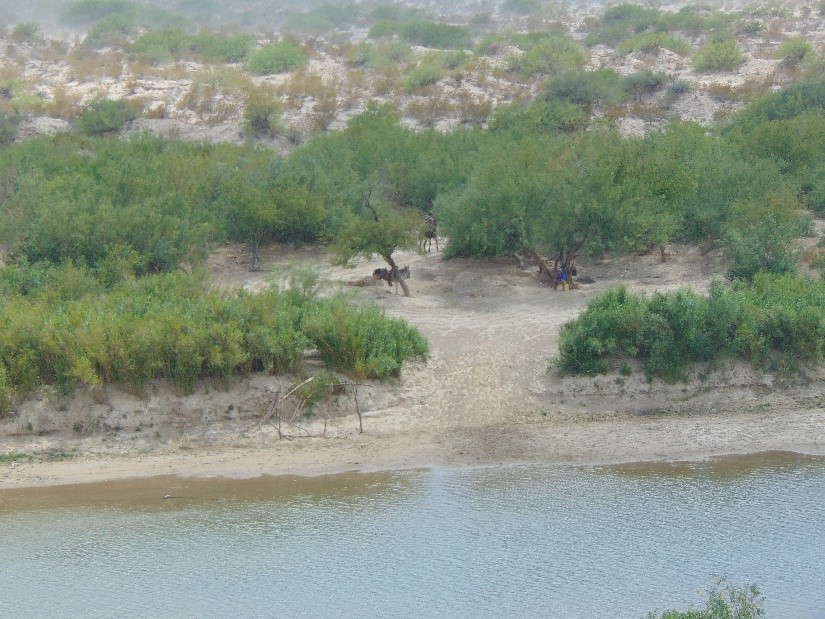
The photos are of the Rio Grande from Big Bend National Park. The photo on the right is looking over to Mexico, there are men with a donkey and horse. When I was visiting there, I wondered why the men were there and if they were transporting people across the river into Mexico. Francisco Cantú talks about this area and having a Mexican man on a horse take him across the river for a meal in Boquillas, Mexico. (page 245)
Module 9.1
Reading: Óscar Martínez, The Beast: Riding the Rails and Dodging Narcos on the Migrant Trail
The stories in The Beast are about Central American migrants who trek across Mexico to reach the United States for a better life. To write this book, Óscar Martínez placed his life in danger and went where other journalist do not venture, on the migrant routes. Each chapter provides a first-hand perspective, through interviews, of the life of a migrant and others that are interconnected with this terrifying lifestyle. This book offers an inside look of the U.S.-Mexico border from the other side, the side of those who will do anything for a chance to live in the United States of America.
Many migrants head north to flee the economic devastation of their countries, and out of fear for their lives. They are threatened by gangs taking over their neighborhoods and businesses, bringing extortion, rape, and murder. There are many more dangers awaiting them on the road to freedom, and they may never make it to their destination. “All are in flight from fear, only to exchange it for the different, unrelenting fear they will discover and learn to endure on the journeys north, with little chance of ever actually reaching the United States” (Martínez, 2013, p. xi). The stories written about these migrants are very personal and very disturbing. Along their journey, they will be preyed upon by fellow migrants, coyotes, human traffickers, bandits, kidnappers, police, immigration, gangs, narcos, and the cartel – they will be robbed, raped, enslaved, kidnapped, and murdered. Some may be forced into prostitution, narco assassin squads, or drug trafficking. “The suffering that migrants endure on the trail doesn’t heal quickly” (Martínez, 2013, p. xiv).
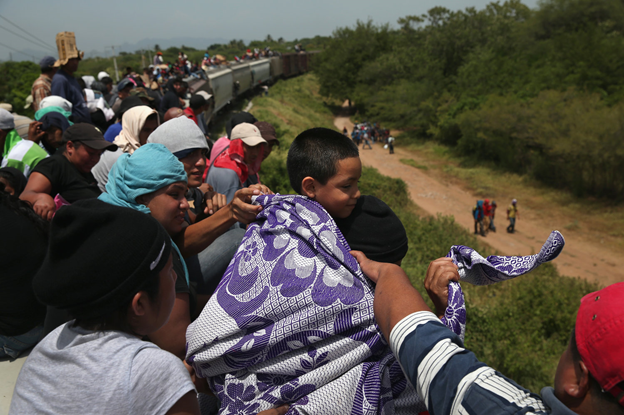
Martínez travels the migrant routes, with the migrants, listening to the stories of what they have experienced along their journey. He travels the same methods they do, by foot, by bus, and by train. The rail travel is atop the roof of freight trains, also known as La Bestia, The Beast, snake, machine, monster, and its history is soaked with blood. The law of The Beast is give up, kill, or die. Migrant stories are those of survival. “Martinez shows how rugged and capable they often are… and how bravely they often fight back, protecting their companions and their women from being forced off the train and herded in the forest” (Martínez, 2013, p. xv). Martinez felt the best place to chat with a migrant is on top of the train, where you are considered equal, in their territory, you signed a pact of solidarity, you share cigarettes, water, food, and defend the train from attack, if necessary.
The stories are heartbreaking and horrendous. It could not be easy to hear what the migrants have endured for una vida major, a better life. “Óscar Martínez writes really, really well with liveliness, precision, vividly observed detail, and restraint which it must have been difficult to sustain considering the rage he often felt over what he was witnessing” (Martínez, 2013, p. ix). When asked by the migrants why he is there, he tells them, “to tell your story”. You hope telling these stories can make a difference in the migrant’s plight, but that is probably not possible at this time. “Out of indifference, moral mediocrity and fear, the Central American migrants’ plight has gone mostly unnoticed in Mexico and the United States” (Martínez, 2013, p. xv). In 2009, National Commission of Human Rights recorded 10,000 kidnapping cases in Veracruz alone. “These are the kidnappings that don’t matter” (Martínez, 2013, p. 93).
The book is not just about migrants, but there are also stories of families, prostitutes, slaves, coyotes, ranchers, townspeople, shopkeepers, border patrol agents, gangs, the cartel, and more. Everyone is involved, everyone is taxed, and no one is safe from the cartel, who is at the top of the chain. Crimes aren’t reported because of fear of deportation or death, and because no one can be trusted.
The chapters in the book are divided by stories. The first half includes the migrant’s personal stories, why they left home, their experiences on the trail, and their struggles on The Beast. The second half of the book looks at the border and the dangers of the crossing. There are stories of where the migrants are not welcome and where they are funneled to, and the ghost towns that remain after a migrant crossing has changed. There are stories of the extortion (taxes) that must be paid by everyone along the line and how the taxes are affected by situations and what happens when you don’t pay. Everything along the border is controlled by the cartel, you do nothing on the Mexican side without their knowledge. In the end, it is all controlled by the cartel. This is a story from the other side of the border. One that is not easily shared with this side…
References
Martínez, Ó. (2013). The Beast: Riding the Rails and Dodging Narcos on the Migrant Trail. Brooklyn, NY: New Left Books.
Riding The Beast (John Moore/Getty Images) http://npr.org
 Book Reviews for Border Issues US/Mexico Relations